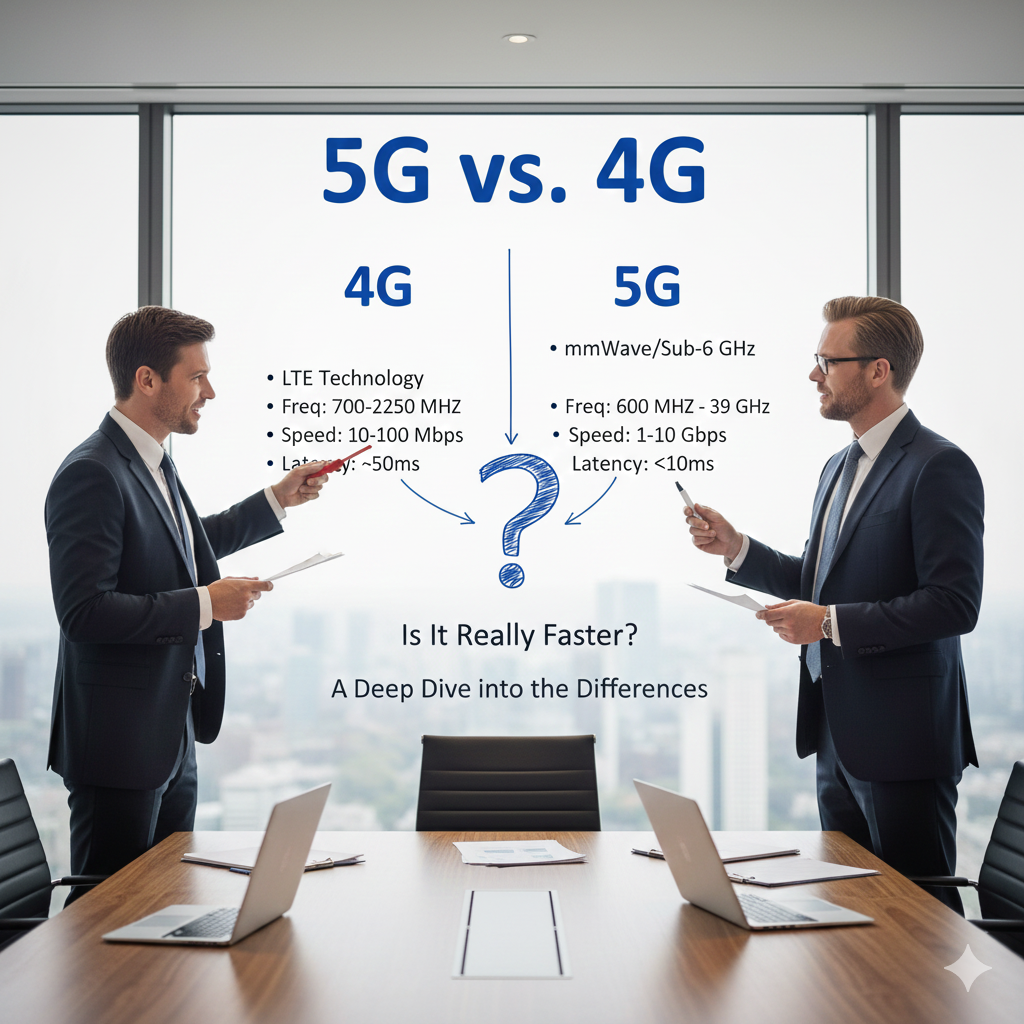
For anyone with a smartphone, the transition from 4G to 5G has been one of the most hyped technological shifts in recent years. Advertisements promise blistering speeds, instant downloads, and a revolution in how we connect. But when you look at your own phone, you might sometimes wonder: Is 5G really that much faster than 4G, or is it just marketing? The answer is more nuanced than a simple yes or no. The true difference between 5G and 4G extends far beyond just speed; it’s about building a new connective fabric for our digital future. In this deep dive, we’ll separate the hype from reality and explore what 5G truly offers.
What Are 4G and 5G?
Before comparing, let’s define our terms.
4G (Fourth Generation), fully implemented as LTE (Long-Term Evolution), was a monumental leap from 3G. It transformed mobile internet from a basic utility into a robust platform capable of streaming HD video, enabling sophisticated mobile gaming, and supporting the app economy we rely on today. Its primary goals were high data rates, seamless mobility, and universal connectivity.
5G (Fifth Generation) is the latest global wireless standard. It is designed not just to be a faster version of 4G, but to be a unified, more capable platform that connects everyone and everything—devices, machines, and objects. It is engineered to meet the exponential growth of data and connectivity in our modern world.
Head-to-Head: The Core Differences Between 5G and 4G
The evolution from 4G to 5G can be understood through several key technological pillars. The following table summarizes the fundamental shifts.
| Feature | 4G (LTE) | 5G | Real-World Implication |
|---|---|---|---|
| Peak Data Rate | ~1 Gbps | ~10-20 Gbps | Download a full HD movie in seconds vs. minutes. |
| Latency | 30-50 milliseconds | As low as 1 millisecond | Near-instant response; critical for remote surgery, competitive gaming. |
| Connection Density | ~100,000 devices per sq. km | ~1 million devices per sq. km | Supports massive IoT networks (smart cities, sensors). |
| Network Efficiency | Good | Highly Improved (Network Slicing) | Tailored networks for specific needs (e.g., a slice for emergency services). |
| Frequency Bands | Primarily sub-6 GHz (low/mid-band) | Low-band, Mid-band, High-band (mmWave) | MmWave enables extreme speeds but with very short range. |
| Mobility Support | Optimized for high-speed travel (e.g., trains) | Enhanced support | More reliable connections in moving vehicles. |
1. Speed: The Most Advertised Difference
This is the headline metric, and yes, 5G is architecturally capable of being significantly faster.
-
4G Speeds: Typical real-world downloads range from 10-50 Mbps, with peak theoretical speeds around 1 Gbps under ideal, rarely-seen conditions.
-
5G Speeds: This is where it gets complex. 5G operates on three distinct spectrum bands, each with different speed profiles:
-
Low-Band (Sub-1 GHz): Offers wide coverage and good wall penetration. Speeds here are often similar to, or only modestly better than, a good 4G connection (20-100 Mbps). This is the “blanket coverage” layer.
-
Mid-Band (1-6 GHz): The sweet spot. Balances speed and coverage, delivering speeds typically between 100-900 Mbps. This is where most users will feel a tangible, dramatic speed upgrade.
-
High-Band (mmWave/24-47 GHz): The superhighway. Capable of multi-gigabit speeds (over 1 Gbps). However, its range is extremely short (a few city blocks) and it is easily blocked by walls, windows, and even leaves. You’ll find this in dense urban centers, stadiums, and airports.
-
Verdict: Is it faster? Yes, but context is everything. Your experience depends entirely on which type of 5G you’re connected to. Mid-band and mmWave are transformative; low-band feels evolutionary.
2. Latency: The Invisible Game-Changer
If speed is how much data you can download per second, latency is the delay before that download begins. It’s the reaction time of the network.
-
4G Latency: Ranges from 30 to 50 milliseconds. This is fine for most applications.
-
5G Latency: Aims for a theoretical ultra-reliable low latency of 1 ms. Real-world deployments currently achieve 10-20 ms, which is a substantial improvement.
Why does this matter? Low latency enables applications where instantaneous response is non-negotiable:
-
Cloud Gaming: Press a button, and the action happens on screen with no perceptible lag.
-
Augmented/Virtual Reality: Eliminates motion sickness and creates seamless interactive experiences.
-
Industrial Automation: Allows for precise real-time control of machinery and robotics.
-
Autonomous Vehicles: Enables cars to communicate with each other and infrastructure instantly to avoid accidents.
3. Capacity and Connectivity: Beyond Smartphones
This is arguably the most profound difference between 5G and 4G. 4G was built primarily for phones and tablets. 5G is built for the Internet of Things (IoT).
-
4G Capacity: Can support about 100,000 devices per square kilometer. In a crowded concert or downtown area, this can lead to network congestion and slow speeds.
-
5G Capacity: Designed to support over 1 million devices per square kilometer.
This massive leap allows for:
-
Smart Cities: Networks of connected traffic lights, environmental sensors, and utility meters.
-
Dense Events: Seamless connectivity for everyone in a stadium, all streaming and posting simultaneously.
-
Industrial IoT: Thousands of sensors in a factory communicating status and performance data in real time.
4. Reliability and Network Slicing
5G introduces a revolutionary concept called network slicing. Imagine a single physical network that can be divided into multiple virtual, independent networks.
-
A slice can be dedicated to emergency services, guaranteeing their connection never falters.
-
Another slice can be optimized for massive IoT sensor data, prioritizing efficiency over speed.
-
A third slice could be a premium, high-speed lane for mobile broadband users or specific enterprise applications.
This allows for unprecedented customization and reliability for critical services, a feature 4G simply does not possess.
The Real-World User Experience: What You Actually Feel
So, with all this technology, what does the average user on Technovasx notice day-to-day?
-
In a Major City with Mid-Band/MMWave: The difference is stark. Downloads are near-instantaneous. 4K video streaming starts without a hint of buffering. Video calls are crystal clear. The experience feels “frictionless.”
-
In Suburban/Rural Areas on Low-Band 5G: The experience is often very similar to a strong 4G LTE connection. Speeds are good and reliable, but not mind-blowing. The benefit here is often less about peak speed and more about added network capacity to reduce congestion as more users join.
-
For Gamers and Tech Enthusiasts: The reduced latency on 5G is a tangible benefit, making cloud gaming services like Xbox Cloud Gaming or NVIDIA GeForce Now far more playable on the go.
-
For the IoT Ecosystem: While not immediately visible to consumers, this capacity enables the next wave of smart home devices, wearables, and connected cars to work together more efficiently.
Challenges and Considerations in the 5G Rollout
The transition to 5G is not without its hurdles, which also explain why the experience isn’t uniformly faster everywhere:
-
Infrastructure Density: Especially for mmWave, carriers need to install small cells every few hundred feet. This is a massive, costly, and slow logistical undertaking.
-
Device Compatibility: You need a 5G-capable smartphone or device to access the network. Older 4G devices cannot connect.
-
Battery Life: Early 5G modems and the search for weaker high-frequency signals could lead to increased battery drain. However, this is improving rapidly with newer chipsets and more stable networks.
-
Coverage Gaps: Moving between different types of 5G coverage (e.g., from a mmWave zone to a low-band zone) can sometimes cause hiccups, though carriers are improving handoff technology.
The Verdict: Is 5G Really Faster?
Yes, 5G is architecturally and demonstrably faster and more capable than 4G. However, the blanket statement “5G is faster” oversimplifies the reality. The rollout is a spectrum (literally):
-
On mid-band and mmWave networks, 5G is a revolutionary leap in speed, responsiveness, and capacity.
-
On widespread low-band networks, 5G is an evolutionary step that primarily improves coverage and network capacity, with modest speed gains for now.
The ultimate difference between 5G and 4G is that 4G was about connecting people, while 5G is about connecting an intelligent world. Speed is just one facet. The lower latency, massive device capacity, and network slicing are what will truly unlock new industries and technologies—from autonomous logistics to remote healthcare and truly immersive metaverse experiences.
For the latest breakdowns on evolving technologies like this, the team at Technovasx remains committed to providing clear, authoritative analysis. The journey to full 5G implementation is still underway, but its foundation is set to be the backbone of our digital future for the next decade.
Further authoritative reading on wireless standards:
-
The National Institute of Standards and Technology (NIST) has ongoing research into 5G and next-generation wireless communication.
-
The Federal Communications Commission (FCC) provides consumer guides on 5G technology and deployment .